

Being in-house is a completely different job
A good in-house role will see you doing almost zero legal work


By Rob Green.
The legal profession stands at a crossroads where traditional career paths are being fundamentally redefined. For lawyers contemplating the transition from private practice to in-house counsel, the reality is far more transformative than many anticipate.
This isn't merely a change of employer or working environment—it's a complete career metamorphosis that requires a fundamentally different skill set, mindset, and approach to professional success.
The Statistical Reality: Two Different Professions
The numbers paint a stark picture of how dramatically different these career paths have become.
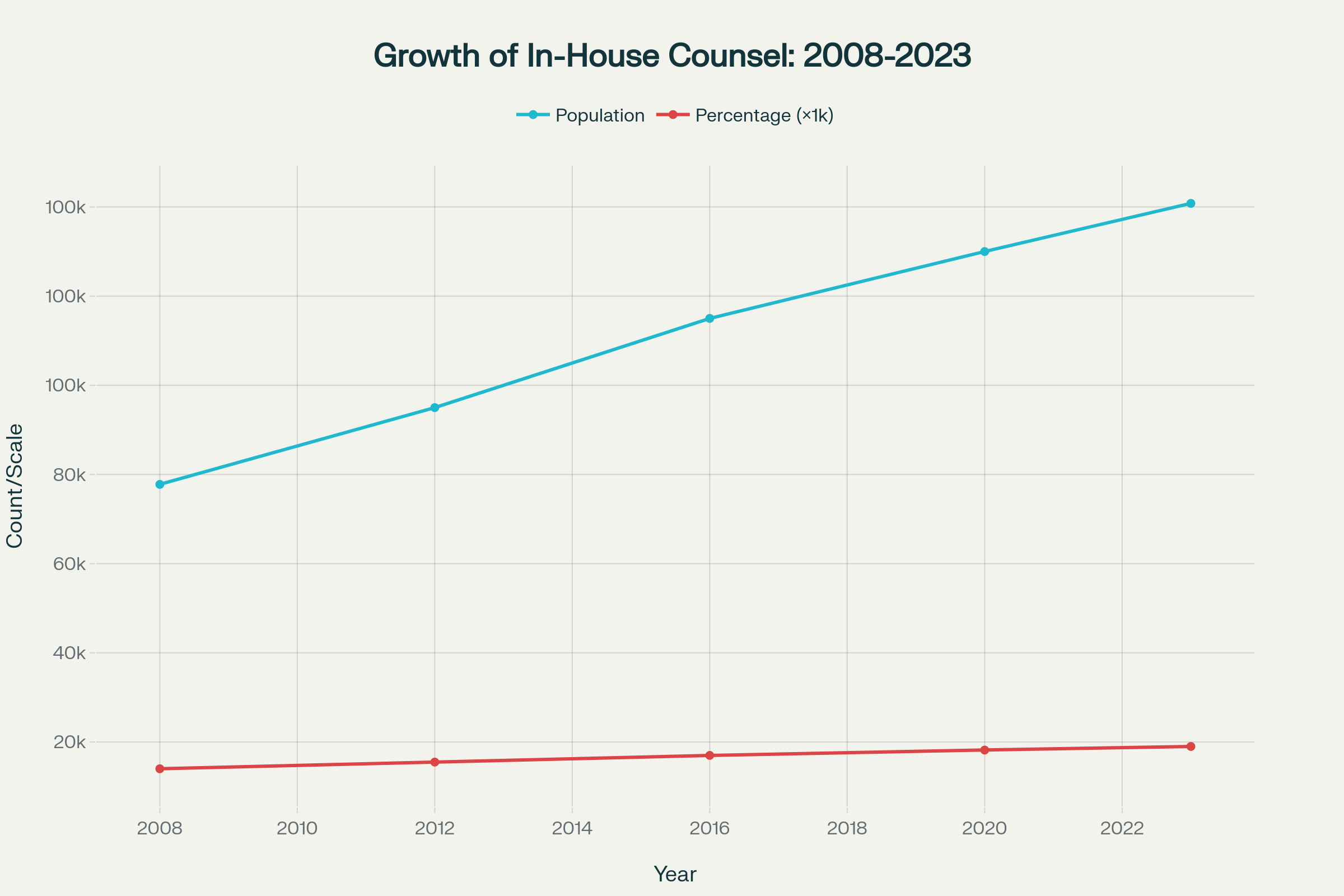
In-house counsel now represents nearly 19% of the total U.S. lawyer population, up from 14% in 2008, with the in-house counsel population surging from 77,780 to 140,800, a remarkable 80% increase over 15 years. This growth reflects not just market preference, but a fundamental shift in what corporate legal work actually entails.
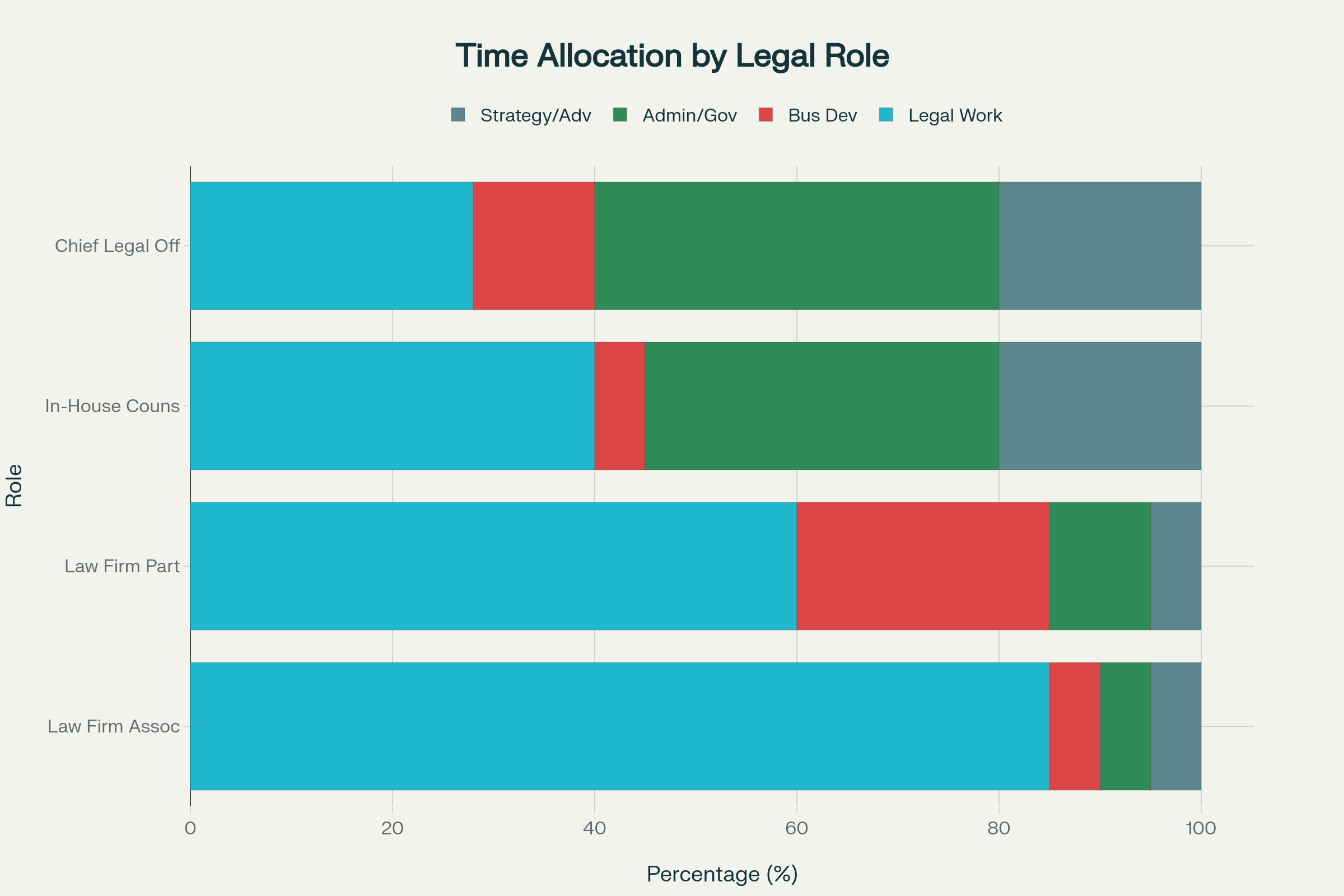
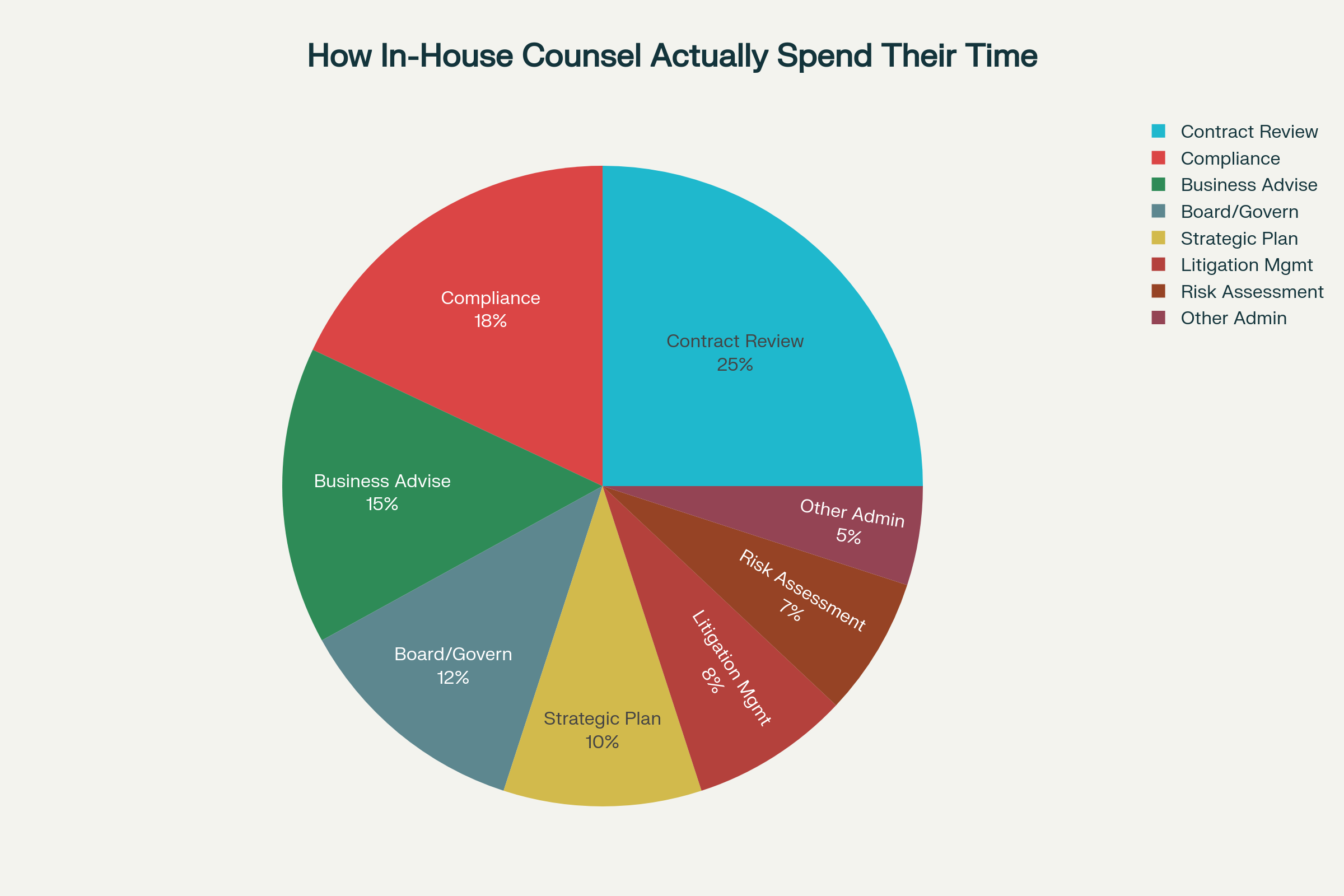
The time allocation statistics reveal the stark reality: Association of Corporate Counsel data shows that Chief Legal Officers spend only 28% of their time providing legal advice, while the remainder involves board matters, governance issues, strategy development, and advising executives on non-legal matters. This is a profound departure from law firm practice, where legal work constitutes the overwhelming majority of daily activities.
The Myth of Better Work-Life Balance
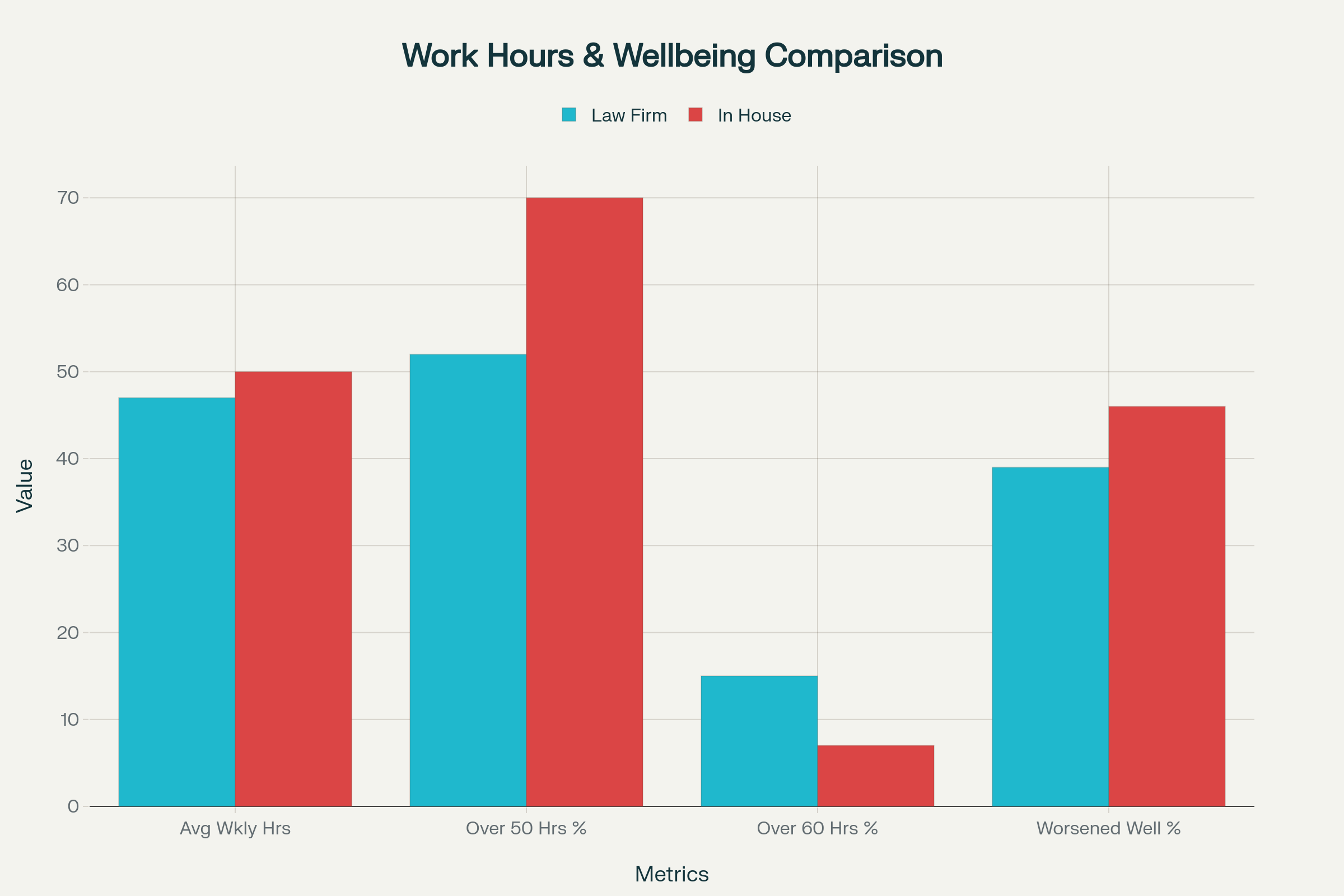
One of the most persistent misconceptions about in-house roles is the promise of improved work-life balance. Bloomberg Law's recent survey shattered this assumption: in-house attorneys reported working 50 hours per week compared to 47 hours for law firm attorneys.
Furthermore, 70% of in-house attorneys experienced increased workloads over six months, compared to just over half of law firm attorneys.
The pressure is intensifying rather than decreasing: 46% of in-house attorneys reported worsened well-being in the first half of 2023, compared to 39% of law firm attorneys. The Association of Corporate Counsel benchmarks show that nearly one-third of in-house lawyers work more than 50 hours per week, with 7% averaging more than 60 hours.
The Fundamental Skills Divide
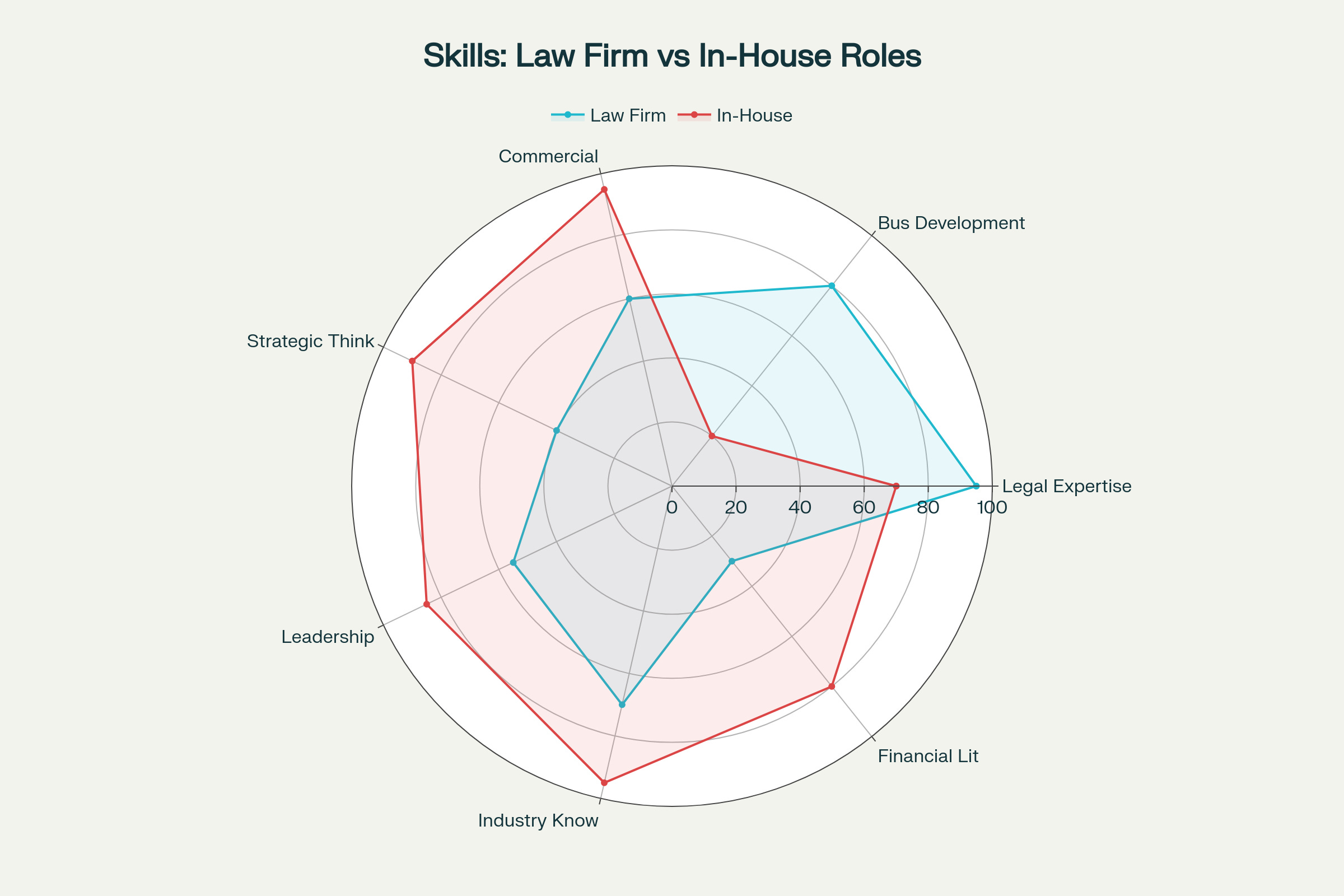
Law Firm Lawyers: Legal Specialists and Business Developers
Law firm lawyers operate in a fundamentally different ecosystem. They must dedicate 8-9 hours weekly to business development activities to be successful rainmakers, with top performers averaging 465 hours annually on client development.
This represents nearly 25% of their working time devoted to non-legal activities, business development, networking, and client relationship management.
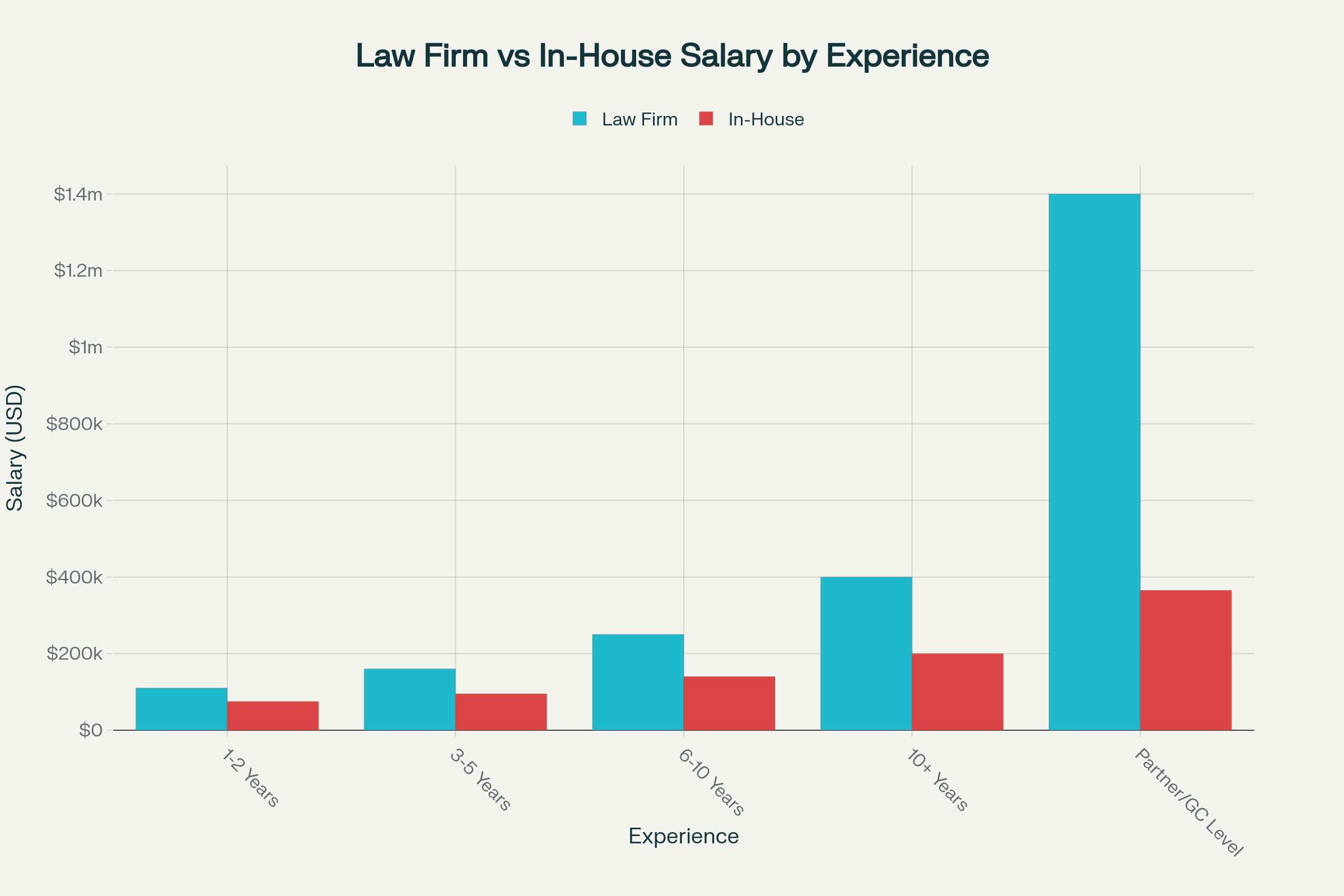
The compensation structure drives this behaviour: law firm partners' earnings are heavily weighted toward origination credit, with average partner compensation reaching $1.4 million in 2024, directly correlated with average partner originations of $3.4 million. Success requires mastering both legal expertise and sophisticated sales skills.
The specialisation imperative: law firm lawyers typically develop deep expertise in narrow practice areas.
This allows them to command premium billing rates, currently averaging between $165,000-$250,000+ for associates depending on experience level, with partners charging significantly higher rates.
In-House Lawyers: Business Partners and Strategic Advisors
In-house lawyers operate as generalists rather than specialists. They must handle everything from contract management to compliance, employment law to corporate governance, often switching between practice areas within a single day.
Contract management alone consumes up to half of in-house legal departments' time and capacity, with 62% of corporate counsel indicating that drafting, editing, and negotiating constitutes at least half of their contract work.
The business skills imperative is non-negotiable. In-house lawyers must master:
Financial literacy: Understanding balance sheets, profit and loss statements, and cash flow statements
Commercial acumen: Aligning legal advice with business objectives rather than providing pure legal analysis
Strategic thinking: Contributing to long-term business planning and risk management
Communication skills: Translating complex legal concepts into actionable business language
The Career Trajectory Reality
Law Firm Path: Partnership or Exit
The law firm partnership track has become increasingly challenging. Average years to partnership have increased from 9 PQE in 2008 to 10.4 PQE in 2017, with many firms requiring 8-14 years for partnership consideration. Only 25% of associates want to make partner at their current firm within five years, reflecting the intensive demands of billable hour requirements and business development expectations.
For those who achieve partnership, the rewards can be substantial. Magic Circle firms report profits per equity partner of £2.5 million at top-tier firms, though this requires sustained performance in both legal delivery and business origination.
In-House Path: From Legal Adviser to Business Executive
The in-house trajectory offers fundamentally different advancement opportunities. Rather than following a single partnership track, in-house lawyers can advance within legal departments, move into business roles, or progress toward C-suite positions. 40% of UK in-house lawyers aspire to become CEOs, recognising that their broad business exposure positions them uniquely for senior executive roles.
The CEO transition is increasingly viable: in-house lawyers develop the exact skills modern CEOs need, problem-solving, risk management, strategic thinking, and cross-functional leadership.
Fortune 500 companies are increasingly promoting internal candidates to General Counsel positions, with 54% of 2024 appointments being internal successors.
The Skills Development Framework for Future CEOs
Essential Business Competencies
For in-house lawyers aspiring to CEO roles, specific skill development is crucial:
1. Cross-Functional Business Understanding
Finance and accounting fundamentals
Operations and supply chain knowledge
Marketing and sales processes
Technology and digital transformation
2. Leadership and Management Excellence
Team building and talent development
Change management and organisational transformation
Performance management and accountability systems
Cultural development and values alignment
3. Strategic Thinking and Execution
Long-term vision development
Market analysis and competitive positioning
Innovation and growth strategy
Stakeholder management and communication
Transitional Experience Requirements
Successful CEO transitions require broadening beyond pure legal roles. This might involve:
Leading cross-functional projects during mergers or acquisitions
Taking operational responsibility for business units
Managing P&L accountability for divisions
Developing expertise in the company's core industry dynamics
The Compensation Reality Check
The financial implications of choosing in-house vary significantly by career stage. Junior in-house lawyers in London average £62,000 compared to law firm counterparts who may earn significantly more. For lawyers with 3-5 years experience, the gap widens: £74,000 in-house versus £110,000 in private practice.
However, the long-term financial picture can be more complex. In-house roles often include:
Equity participation in company growth
Performance bonuses tied to business success
Potentially lower stress and longer career sustainability
Opportunities for dramatic wealth creation through company acquisitions or IPOs
General Counsel compensation has reached substantial levels: median pay for GCs and CLOs reached $365,000 in 2024, up 9% year-over-year. At larger companies, total compensation packages can reach well into seven figures when including equity and bonuses.
The Strategic Career Decision: When Law Firm Practice Makes Sense
Choose the law firm path if you
Enjoy deep specialisation in specific legal areas
Thrive on variety in clients and matter types
Are motivated by business development and networking
Value the potential for high earnings through partnership
Prefer project-based work with clear beginnings and endings
When In-House Practice Aligns with Your Goals
Choose the in-house path if you:
Prefer broad generalist work across multiple practice areas
Want to understand business operations comprehensively
Aspire to senior executive leadership roles
Value long-term strategic thinking over transactional work
Are energised by being part of an organisation's growth story
The Transition Timeline and Preparation
For lawyers considering the in-house transition, timing is crucial. Industry experts recommend at least 4-5 years of solid law firm experience before moving in-house, as insufficient grounding in legal fundamentals makes it virtually impossible to return to firm practice later.
The most successful transitions involve:
Secondment opportunities to gain in-house exposure
Developing commercial awareness through industry-focused work
Building relationships with in-house teams at client organisations
Cultivating business skills through formal training or MBA-level coursework
The Future Landscape
The trend toward in-house legal functions is accelerating. Thomson Reuters data shows that 54% of UK general counsel expect to handle a higher proportion of work in-house over the next five years, while 28% of corporate legal departments plan to decrease total external legal spending in 2025.
This shift reflects several factors:
Cost effectiveness: in-house lawyers cost 59% of associate billing rates and 40% of partner rates
Business integration: companies want legal advisors who understand their industry and culture
Strategic value: in-house lawyers contribute to business strategy rather than just legal compliance
Risk management: internal teams can proactively manage risks rather than react to problems
In conclusion
The choice between law firm and in-house practice represents one of the most significant career decisions a lawyer will make. These are not merely different employers or working environments, they are fundamentally different professions requiring distinct skill sets, mindsets, and career development strategies.
Law firm practice remains the path for lawyers who want to be legal experts first and foremost, developing deep specialisation while building substantial business development capabilities. The financial rewards can be substantial, but success requires mastering both legal excellence and sophisticated rainmaking skills.
In-house practice is increasingly the path for lawyers who want to be business leaders who happen to have legal training. The work involves minimal pure legal analysis and maximum business strategy, risk management, and organisational leadership. For those aspiring to CEO roles or senior executive positions, the in-house path provides unparalleled preparation.
The statistics are clear: this is not about choosing between similar roles with different employers. This is about choosing between two fundamentally different career trajectories, each requiring different skills, offering different rewards, and leading to entirely different professional destinations. The lawyers who succeed in either path are those who understand this distinction and prepare accordingly from the earliest stages of their careers.
The legal profession's evolution has created two distinct career paths that, while both requiring legal training, lead to fundamentally different professional lives.
The choice between them should be made not based on outdated assumptions about work-life balance or simple preference, but on a clear understanding of which professional identity aligns with your long-term career aspirations and personal strengths.